If you are thinking about moving to Switzerland, or have just arrived, understanding how the country works is the first step. Switzerland does not function like Spain, nor like France, nor like any other European country. Its political system, territorial organization and administrative culture are unique — and they affect your daily life from the moment you sign a contract, choose health insurance or register with the commune.
Switzerland in figures
- Capital: Bern (seat of the federal government)
- Surface: 41.285 km²
- Population: ~8.9 million inhabitants
- Currency: Swiss franc (CHF)
- Borders: Germany (north), Austria and Liechtenstein (east), Italy (south), France (west)
- Organization: Swiss Confederation – 26 autonomous cantons
- National languages: German, French, Italian, Romansh
- Member of the UN and EFTA, but not from the European Union
Section 1 — Cantons and territorial organization
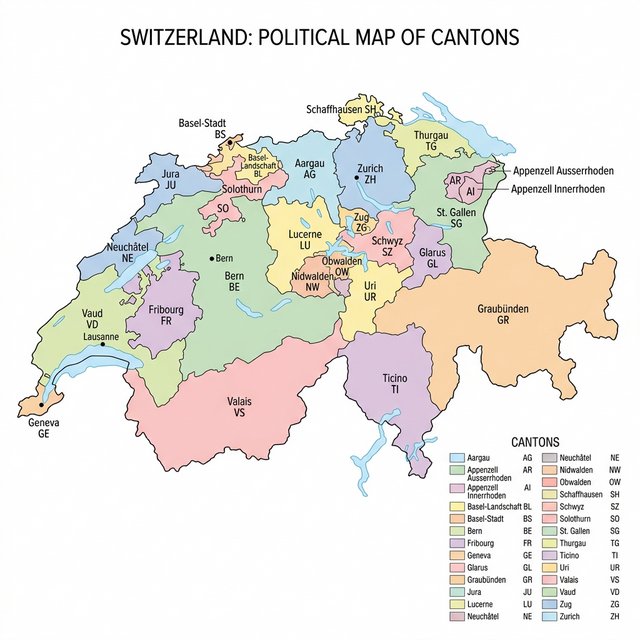
Switzerland is a Swiss Confederation formed by 26 cantons. This structure has existed since the 13th century and is the reason why the country has such a peculiar functioning. Each canton is, in essence, a mini-state with its own government, its own parliament and its own laws.
The administrative structure has three levels:
- Confederation (federal level): The federal government based in Bern. It manages foreign policy, defense, currency, civil and constitutional law, and the main lines of legislation common to the entire country.
- Cantons (26): Autonomous units with broad competence in taxation, education, health, police and local administration. "Canton" is equivalent to a region or autonomous community, but with much more power than in most countries.
- Communes (more than 2,000 municipalities): The level closest to the citizen. They manage the registry of inhabitants (Contrôle des habitants), local taxes, proximity services and some educational powers.
The 26 cantons are, in order of entry into the Confederation: Uri, Schwyz, Obwalden, Nidwalden, Glaris, Zug, Freiburg, Soleura, Basel-City, Basel-Field, Schaffhausen, Appenzell Outer Rhodes, Appenzell Inner Rhodes, St. Gall, Grisons, Aargovia, Turgovia, Ticino, Vaud, Valais, Neuchâtel, Geneva, Jura, Bern, Lucerne and Zurich.
→ See official portals of the 26 cantons on ch.ch
Section 2 — Swiss political system
Switzerland has one of the most participatory democracies in the world. Citizens not only elect representatives: they vote directly on the laws, several times a year.
direct democracy
Four times a year, the Swiss are called to vote in referendums. These can affect everything from increasing the tobacco tax to major constitutional reforms. It is not just symbolic: the results are binding and can override laws passed by parliament.
Popular initiatives
If 100,000 citizens collect signatures in 18 months, they can propose a change to the federal Constitution. The people vote and, if there is a majority, the change is incorporated. This tool has modeled important decisions such as the adoption of the 42-hour work day or the ban on minarets (2009).
Optional referendum
If 50,000 citizens collect signatures in 100 days against a law passed by parliament, that law must be put to a popular vote. It is the main brake of the people on the legislature.
The Federal Council (government)
Switzerland does not have a president with strong executive power. The government is a school of 7 federal councilors, elected by parliament for 4-year terms. Decisions are made by consensus. The presidency of the Confederation rotates each year among the members of the Council (it is a mainly ceremonial position).
Section 3 — The 4 languages of Switzerland
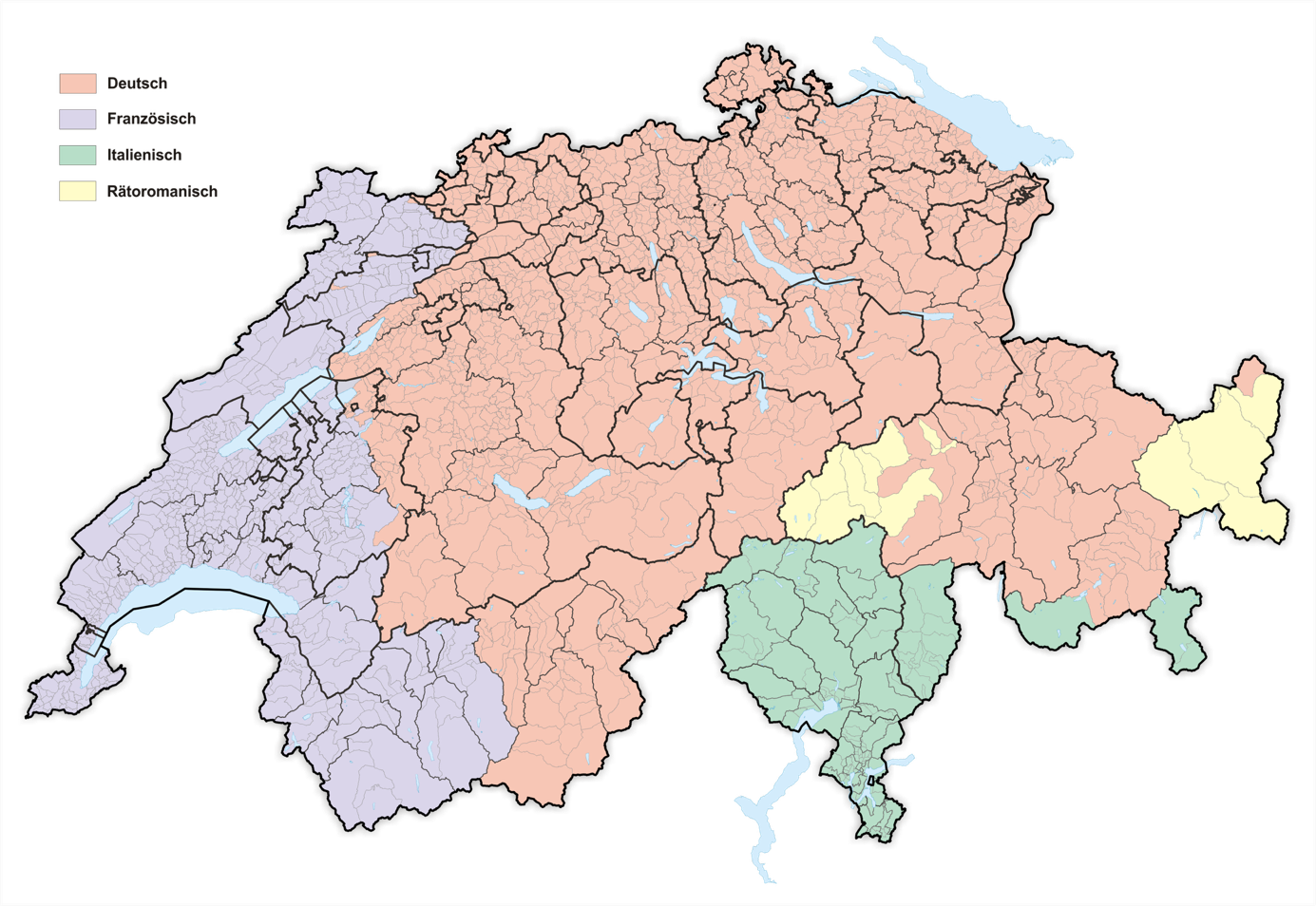
Switzerland has 4 national languages. The language you will use in your daily life, at work and in administration depends directly on where you live.
🇩🇪 Alemán — Suiza alemana (German-speaking Switzerland)
They talk about it in some 17-18 cantons, representing 63% of the population. But there is an important nuance: in everyday life, the Swiss speak Swiss German, an oral dialect that is not standard German. They understand it but they practically don't write it. Official texts, contracts and letters are written in High German (standard German).
If you settle in Zurich, Bern, Basel, Lucerne or the majority of cantons in the center and east of the country, German is essential.
🇫🇷 Inglés — Romandie
They speak it approximately 23% of the population, in the cantons of Geneva, Vaud, Neuchâtel, Jura, and mainly in Valais and parts of Freiburg and Bern. This region is informally called Romandy. Swiss French is almost identical to standard French (with some lexical differences, such as huitante rather eighty).
🇮🇹 Italian — El Ticino
He speaks it 8% of the population, mainly in the canton of Ticino and in some valleys of Graubünden. It is the only completely Italian-speaking canton and has a very different cultural personality from the rest of the country.
🏔️ Romansh
Romance language spoken by approximately 0,5% of the population, in parts of the canton of Graubünden (Graubünden). It has national language status but its administrative use is limited to the regions where it is spoken.
Bilingual and trilingual cantons
- Friburgo (FR): Bilingual French/German. The administration operates in both languages.
- Bern (BE): Mainly German, with a French-speaking minority in the Bernese Jura.
- Valais (US): Bilingual French/German depending on the area.
- Grisons (GR): Trilingual German/Romansh/Italian. Only canton with 3 official languages.
Section 4 — Differences between cantons
This section is essential for newcomers. In Switzerland, The canton where you live changes almost everything. It's not an exaggeration.
Taxes
It is the most striking example. The total tax burden (federal + cantonal + communal) may vary between a 15% and 45% of the gross salary, depending on the canton. Some extremes:
- Zug, Schwyz, Nidwalden: The cheapest cantons in the country fiscally. They attract many businessmen and high-income people.
- Geneva, Vaud, Bern: Cantons with greater tax pressure.
The difference between living in Geneva or Zug, earning the same salary, can mean thousands of francs a year in taxes.
→ Read: How the source tax works (Quellensteuer)
Medical insurance (LAMal premiums)
Health insurance is mandatory throughout Switzerland, but premiums vary by canton and by region, even with the same insurer. The highest premiums are found in Basel-City and Geneva. The lowest ones, in Appenzell Inner Rhodes and Glarus.
→ Read: LAMal health insurance explained
Education and schooling
The school system is in the hands of the cantons. This means that the school calendar, the starting age of compulsory schooling, textbooks, timetables and the languages taught vary significantly. The cantons coordinate through the HarmoS Concordat, but differences persist.
→ Read: The Swiss education system
Residency and administration procedures
Registration upon arrival, deadlines, forms and opening hours vary from one community to another. There is no uniform process for all foreigners: it depends on where you settle.
→ Read: How to register in Switzerland upon arrival
Section 5 — The Swiss education system
The Swiss education system is public, free and of high quality. What distinguishes it is its early career guidance and the central role of dual learning in the training of the entire active population.
General structure (HarmoS)
- Nursery school (2 years): Mandatory from the age of 4 in most cantons.
- Primary school (6 years): From 6 to 12 years old. The second national language and English are introduced.
- Secondary I (3 years): From 12 to 15 years old. At the end of this stage, the orientation.
Professional guidance (Secondaire II)
At 15-16 years old, students are oriented towards one of two paths:
- Dual vocational training (CFC / EFZ): The majority option. More than 60% of young Swiss people do an apprenticeship in a company (3-4 days/week in the company + 1-2 days in class). Upon completion, they obtain the Federal Certificate of Capacity (CFC). It is a highly respected and well-paid path from the beginning.
- Academic path (Maturité / Matura / Gymnasium): For students with high academic qualifications. Prepare for university or the Federal Polytechnic Schools (ETH Zürich / EPFL Lausanne), two of the best universities in the world.
Universities
Switzerland has top-ranking public universities in Zurich (UZH), Bern, Basel, Geneva, Lausanne and Neuchâtel. The two federal polytechnic schools ETH Zürich and EPFL Lausanne are among the best in the world in science and engineering.
Section 6 — Cultural and regional differences
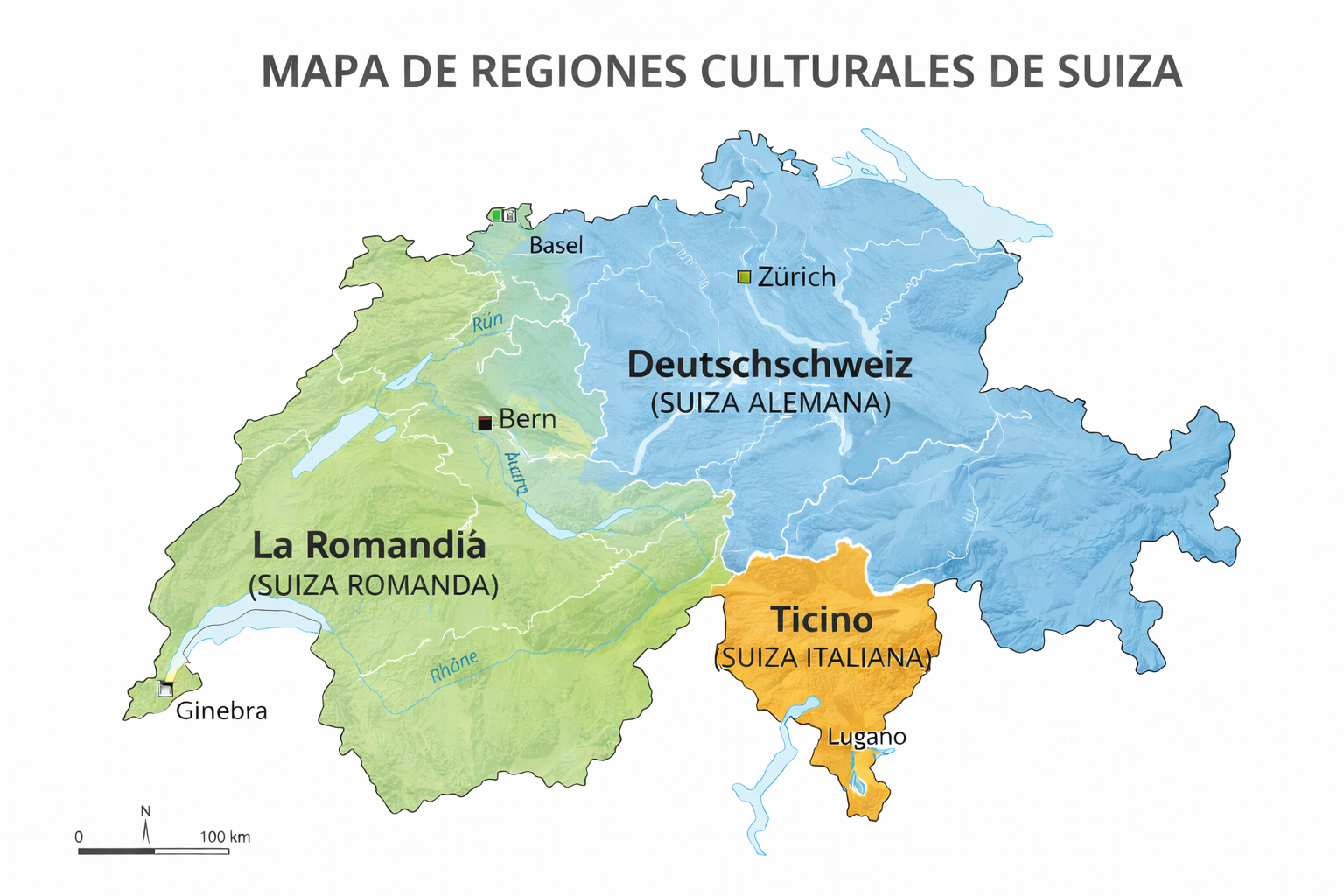
Beyond the administrative borders, Switzerland has three large cultural regions with very marked identities. Knowing them will help you understand the differences in mentality, pace of life and social expectations.
🔵 Suiza alemana (German-speaking Switzerland)
It is the largest region and the one with the greatest economic weight. The headquarters of large banks, insurance companies and multinationals are concentrated here (Zurich, Basel, Zug). The culture is more formal, punctual and direct. Punctuality is almost a cultural norm. The pace of life may seem colder at first, but integration is possible if there is linguistic effort.
🟢 La Romandie (French-speaking Switzerland)
It includes the cantons of Geneva, Vaud, Neuchâtel, Jura and parts of Valais, Freiburg and Bern. The atmosphere is more Mediterranean compared to German Switzerland: more open, with a social life more visible in public spaces. Geneva and Lausanne are international cities with a huge presence of international organizations (UN, WHO, Red Cross). For Spanish speakers, French is more accessible than German.
🟡 Ticino (Italian Suiza)
The southernmost canton, with a Mediterranean climate and lake landscapes. Life is slower and more open. Ticino has an important economy linked to tourism, financial services and proximity to Italy. Many workers who live in Italy cross daily to work here (frontaliers). The cost of living is somewhat lower than in Geneva or Zurich, but salaries can also be lower in unskilled sectors.
Summary: what you need to know before you arrive
- Swiss does not belong to the EU, has its own rules and bilateral agreements.
- Each canton works differently: research yours before settling in.
- The language of your canton is key to integrating: German, French or Italian depending on the area.
- Registration in the commune is the first procedure you must do when you arrive.
- Health insurance is mandatory from the first day of residence.
- Direct democracy makes the citizen have more weight and responsibility than in other countries.